
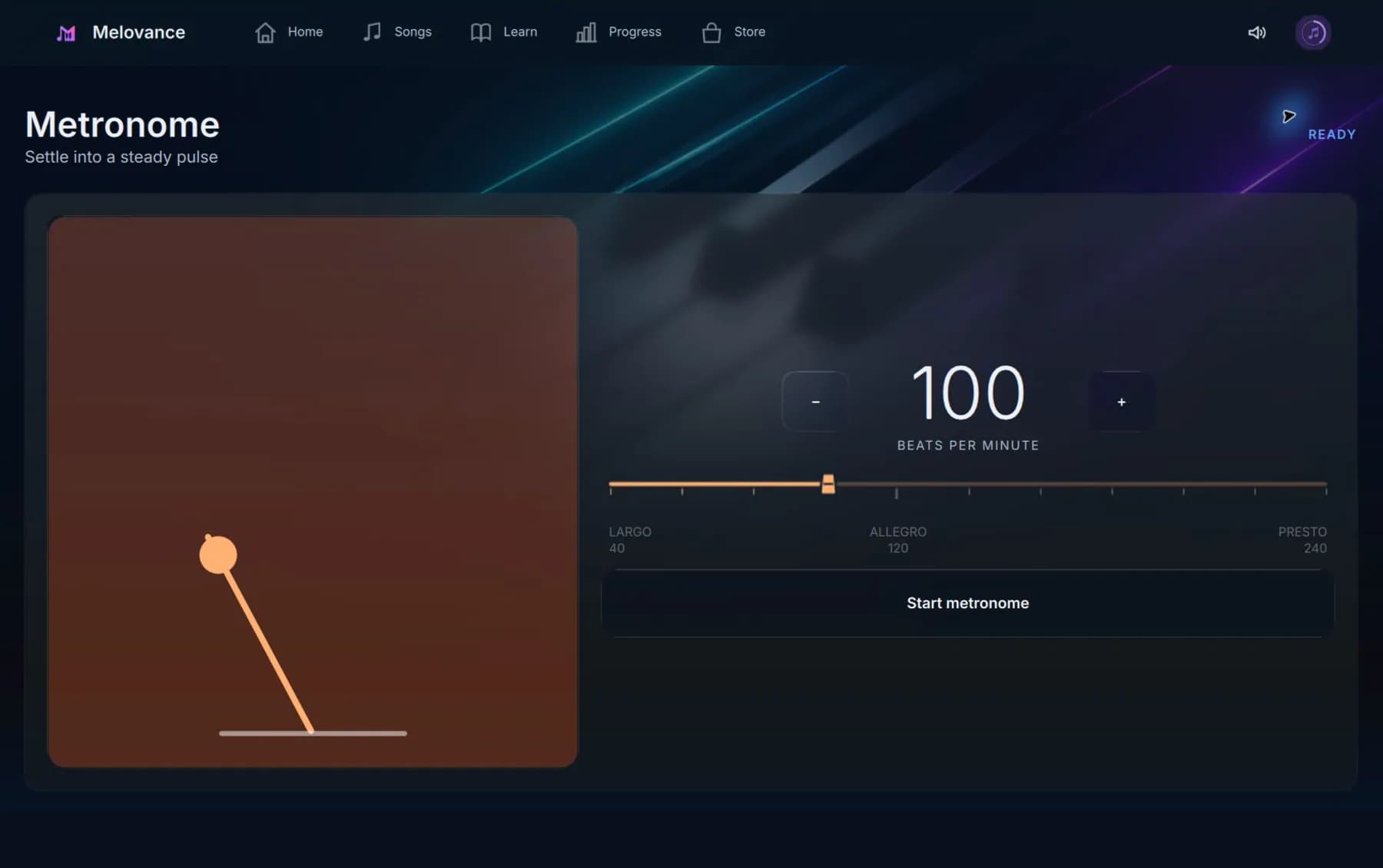
A metronome you can follow
Each click is one beat. Listen to the pulse before you play, then hold and release with the clicks.
Rhythm and timing
Right notes at the wrong time still sound wrong. Melovance teaches pulse, note lengths and rests with a metronome and spoken counting, then listens to when you play and how long you hold each note.
THE BASICS
The pulse is the steady beat you could tap your foot to. Rhythm is how long each note lasts against that beat: a quarter note lasts one beat, a half note two, a whole note four. Rests are beats of silence, and they count just as much as notes.
Many timing problems come from treating rhythm as something you copy by ear. Counting the pulse gives you something to measure against, so you know whether a note starts on the beat and how long to hold it.
HOW MELOVANCE TEACHES IT
Each click is one beat. Listen to the pulse before you play, then hold and release with the clicks.
A voice counts note lengths, rests and entries out loud, so you hear where each note belongs.
Repeat the rhythm yourself in an interactive exercise, with visual feedback as you go.
Practice looks at when you play and how long you hold each note, not just which notes you pressed.
Learn to leave a gap and come back in on time, which is where many learners slip.
The same ideas return inside pieces, so the rhythm you practised shows up in what you play.
COMMON PROBLEMS
Most rhythm problems are habits, and habits can be changed once you can see them.
Speeding up on easy passages or when excited. A slower tempo and counting aloud help.
Filling the silence early. Count the rest as if it were a note.
Lifting before the note has lasted its full length. Hold until the next beat.
Pairs of short notes that wobble. Count the in-between beats evenly.
COMMON QUESTIONS
Use it to build a steady pulse, and also practise without it so you can keep time yourself.
It is very common when a passage feels easy or exciting. Slowing down and counting out loud usually helps.
Yes. A rest is a beat of silence, and playing through it throws everything after it off.
Yes. Practice looks at when you play and how long you hold the notes, and your practice feedback can point to timing as the next thing to work on.
Download Melovance and try a rhythm exercise on your own keyboard.